

Good developer experience
Researchers: M. Pederson & L. Westra
STRATEGIC PRODUCT RESEARCH CASE STUDY
Background & Problem
The organization, a business software company focused on development tools for software engineers, had one successful product line and plans to expand its portfolio. While teams across the organization had deep experience with developers (many were developers themselves) knowledge was fragmented and inconsistent.
Product and design leadership recognized that critical decisions were being shaped by a narrow set of customer voices and internal preferences rather than representative data. To expand confidently into new product lines, the company needed a broader, more rigorous understanding of developers—their workflows, decision-making influence, and expectations.
Research Questions & Methodology
Our objective was to define what “developer experience” and “developer-first” should mean within the context of the organization’s current and future capabilities.
We focused on four core questions:
How should the team approach developer experience from a product strategy perspective?
What differentiates “good” from “great” developer experience?
How do developers influence software purchase decisions?
Which developer segments represent the highest strategic value for the new product lines?
We used a mixed-methods approach:
Review of third-party research on developer workflows and preferences
30 in-depth interviews with software engineers across target markets
A follow-up survey to validate qualitative findings (n = 512, representative sample)
Parallel survey with internal developers (n = 40) to compare internal assumptions with external realities
Qualitative and quantitative data were analyzed independently before being synthesized into a unified set of findings and strategic recommendations.
Key Insights & Impact
Note: This study was conducted prior to the widespread integration of AI into developer workflows.
We defined “good developer experience” specifically for the organization’s product ecosystem and translated that definition into clear prioritization guidelines for the roadmap. This clarity unlocked alignment across product and design as well as influenced the go-to-market motion.
While detailed findings remain confidential, the following slide illustrates the level of insight used to support strategic recommendations.
Significant Research Findings Sample
The order participants ranked their definitions of “good developer experience” varies slightly based on years of coding experience, but the categories they chose are consistent regardless of experience. “Understand how the tool is technically operating” is the outlier, but this is understandable as it was chosen by developers who are still learning how the foundations. Each categories of years of experience is shown in order of ranking with highest first.
Years of coding experience (bolded)
Less than 1 year
Fast - tool runs processes quickly and get what I need
Understand how the tool is technically operating
Active community
Integrates with existing systems
Modern looking UI
1 to 4 years
Active community
Good documentation
Predictable, consistent availability / up-time
Fast - tool runs processes quickly and get what I need
Modern looking UI
5 to 9 years
Active community
Good documentation
Fast - tool runs processes quickly and get what I need
Predictable, consistent availability / up-time
Modern looking UI
10 to 14 years
Good documentation
Active community
Predictable, consistent availability / up-time
Essential information is clear
Integrates with existing systems
15 to 19 years
Good documentation
Integrates with existing systems
Fast - tool runs processes quickly and get what I need
Active community
Modern looking UI
20+ years
Good documentation
Predictable, consistent availability / up-time
Essential information is clear
Integrates with existing systems
Active community
We also painted a nuanced picture of software engineers and how they influence the purchase of new tools. The following graphics are similar to the types of information included in the final report.
Significant Research Findings Sample
Behavioral archetypes focus on our users’ needs, motivations, and pain-points. Archetypes capture how they think, feel, and act in particular situations or scenarios, so we can make accommodations for potential pain points through empathic design. The six archetypes below focus on developers’ behavior towards tool changes, and they help define the targets for the new funnel.

Ladder Climber
I learn about new tooling because I want others to view me as the expert.

Coffee Break & Coder
I use social opportunities to learn about new tools, and I am excited to try them when I have time.

Pragmatist
I prefer to use tools that I know inside and out, but I will use different tools if it is required of my job.

Peacekeeper
I prefer using tools that I know, but I will move into new tools if it makes it easier to collaborate with my team.

Tinkerer
I try all the new tools I learn about, but I rarely switch to them as my go-to tool.
Tool Seeker
I enjoy learning about new technology and frequently switch my primary tool to gain the full experience.
Significant Research Findings Sample
We detailed the role of each archetype in the software purchase cycle.

Coffee Break & Coder
I use social opportunities to learn about new tools, and I am excited to try them when I have time.
"I do personally believe that, you know, the best news is to talk to fellow engineers. I have [a] very good relationship with my university alumni….. So, you know, the best thing [is] if they say, 'oh, we tried this too.' And it's a breeze because obviously you sit down with a beer for friends, you're gonna talk about it. And that to me is very good..." Tech Lead, UK
Coffee Break & Coders’ motivations for tool seeking:
Social butterfly, seeking out opportunities to spend time with people while also learning about tooling
Often an official, or unofficial, leader of the group
Comfortable trying new things
Coffee Break & Coders’ decision making bias:
Best source for gauging their peers’ feelings on tool changes
Strategic impact must be clear before they can make any decisions
Support change management initiatives
Will have a good handle on the latest tool trends
Considerations for working with Coffee Break & Coders
Appreciation: Coffee Break & Coders will bring the team together to make the final tooling decisions and keep people motivated during implementation.
Coping Mechanism: They tend to seek out informal discussions regarding changes. While this may not be premeditated, it can influence the final tooling decision, and lead to the rest of the team feeling like they were not included.
Significant Research Findings Sample
We also broke down influence in the tool process by job function.
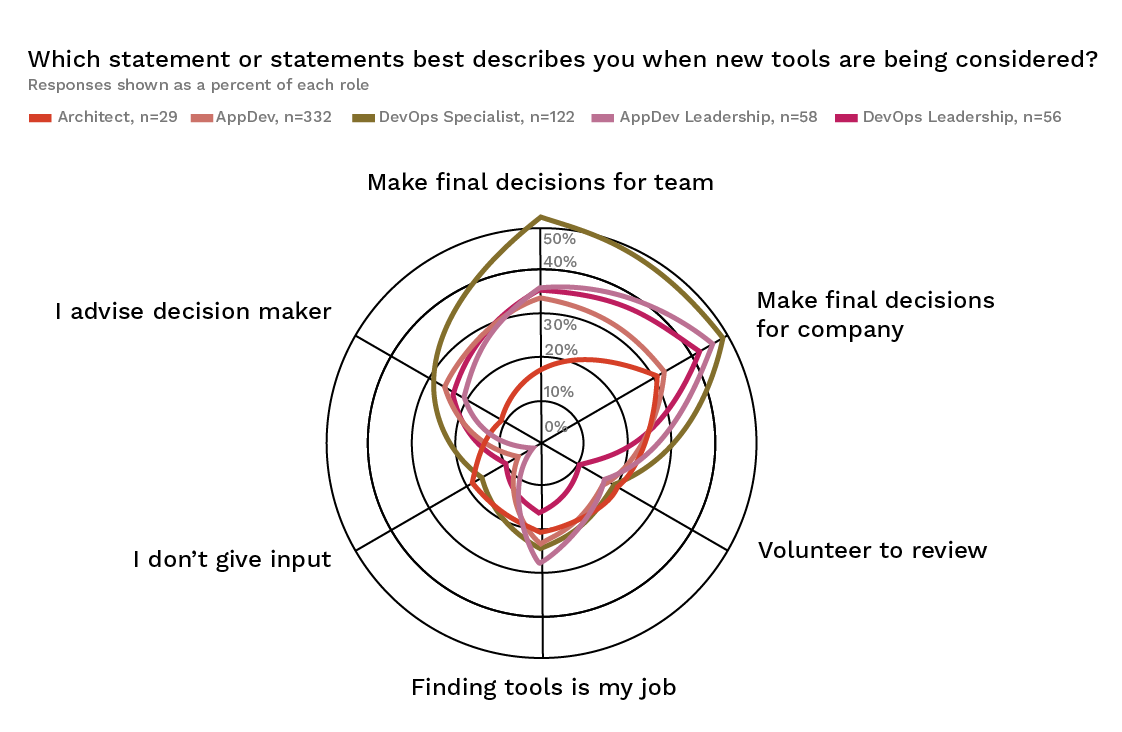
The independent proportion of each role was compared using a right-tailed test after the spider plot was created to see if there was a significantly greater number of decision makers or influencers in any one group. DevOps specialists and AppDev leadership reported making significantly more decisions on tooling for their teams than other roles. DevOps specialists and AppDev make significantly more decisions for their company tooling than other roles. There were no significant differences between the roles for influential power.
| Alt. Hypothesis: DevOps Specialists have significantly more TEAM decision makers than other roles. | ||||
|---|---|---|---|---|
| AppDev | DevOps Leadership | AppDev Leadership | Architect | |
| Z-scores | 3.11 | 2.28 | 1.77 | 3.11 |
| Reject H₀ | Reject H₀ | Accept H₀ | Reject H₀ | |
| Alt. Hypothesis: DevOps Specialists have significantly more decision makers FOR TOOLS THAT IMPACT THEIR COMPANY than other roles. | ||||
| AppDev | DevOps Leadership | AppDev Leadership | Architect | |
| Z-scores | 2.62 | 0.99 | -0.01 | 1.35 |
| Reject H₀ | Accept H₀ | Accept H₀ | Accept H₀ | |
| Alt. Hypothesis: DevOps Specialist has significantly more tooling influencers than other roles. | ||||
| AppDev | DevOps Leadership | AppDev Leadership | Architect | |
| Z-scores | 0.36 | 0.89 | 0.95 | 1.82 |
| Accept H₀ | Accept H₀ | Accept H₀ | Accept H₀ | |