
Culture & impact on product strategy
Researchers: M. Pederson & L. Westra
CASE STUDY
Background & Problem
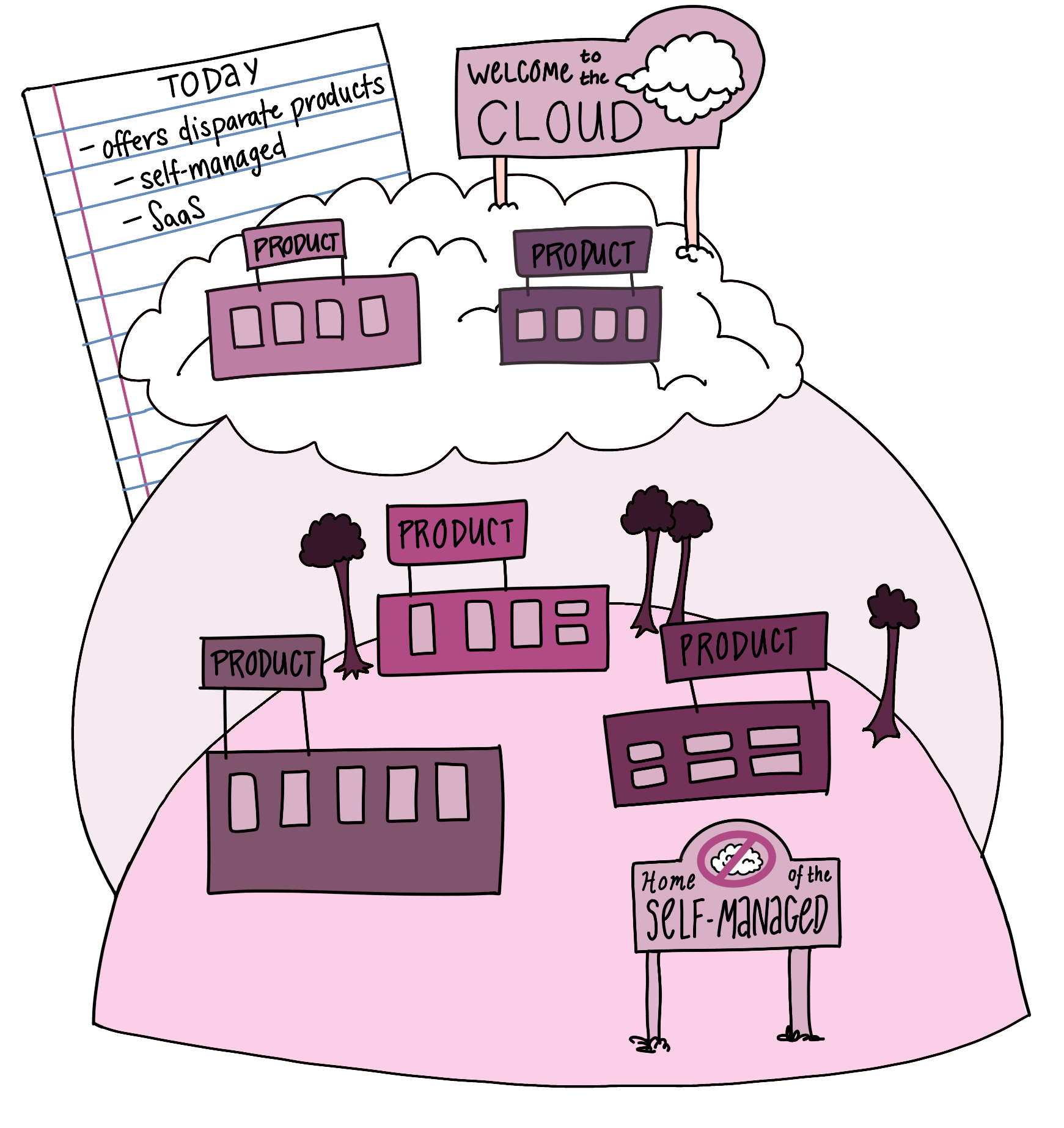
The organization was operating two parallel product lines: a successful, self-managed offering and a planned SaaS product still in development. Product and support teams were structured around these separate pursuits, with minimal cross-functional interaction despite significant overlap in capabilities.
Although the organization had conducted extensive research and multiple future-vision exercises, the three-year roadmap remained ill-defined and product development had stalled. Leadership recognized that structural and process-level misalignment, not lack of effort, was preventing progress. A deeper assessment of internal workflows, decision-making dynamics, and team structure was required to move forward.
Research Questions & Methodology
Our objective was to identify what was preventing the organization from aligning around, and executing against, a shared product vision.
We focused on two core questions:
What are the product priorities for the future?
What are the organizational barriers to integrating customer needs (uncovered through research) into the roadmap?
We conducted in-depth interviews and focus groups with stakeholders from product management, design, engineering, marketing, sales, and security. Participants included individual contributors, managers and directors, and C-suite executives (n=32).
The data was analyzed using the Human Factors Analysis and Classification System (HFACS), a framework originally developed to evaluate systemic breakdowns in complex operational environments. While commonly applied in manufacturing and safety-critical industries, we have found it highly effective for diagnosing structural and decision-making friction within software organizations.
Key Insights & Impact
We identified shared hopes and fears across departments regarding product vision, scalability, and the organization’s ability to meet, or exceed, ARR targets. However, these concerns were rooted in deeper structural misalignment.
The Human Factors analysis surfaced the systemic causes of stalled execution, including unclear ownership, conflicting definitions of the company’s core offering, and divergent understandings of product value across departments. In several cases, internal perceptions of the product differed meaningfully from how customers defined its value.
The company’s upcoming product and resource planning cycle provided a strategic inflection point. Our findings informed the structure and facilitation of alignment sessions, clarified priority tradeoffs, and shaped subsequent leadership and organizational decisions.
Significant Research Findings Sample
The organization succeeded at creating a safe and comfortable working environment on an individual level.
Employees, across levels, reported feeling safe and secure in their positions. The remote-first, distributed nature of the team seemed to enhance individual performance and satisfaction. There was no evidence of discrimination towards mental or physical limitations, and employees seemed to feel they had a healthy work-life balance.
The organization failed at creating a working environment where individuals were able to collaborate with others to advance a shared goal.
Based on the Human Factors framework, we identified the top categories of systemic failure. Correction of the identified failures would lead to a reduction in error as well as an increase in collaboration, ultimately improving team-wide productivity. Below are sample graphics used to illustrate findings.
Significant Research Findings Sample
Summary of Failures using Human Factors Analysis and Classification System
Within each level of HFACS, causal categories were developed to identify active and latent failures. Correcting the failures will lead to a reduction in errors and violations, and ultimately improve productivity.
↓ Highest frequency
Lowest frequency ↑
INADEQUATE SUPERVISION
Staff leaders are not providing adequate guidance, training, leadership, oversight or incentives.
No unified strategy from the top
Lack of product identity and direction
Paralyzed by change fatigue
ORGANIZATIONAL CLIMATE
Poor working atmosphere within the organization (e.g., structure, policies, culture).
Decisions feel panicked and reactive because competition feels unreachable
Poorly communicated product decisions create a speculative, trustless environment
Intrusive cross-functional actions
CREW RESOURCE MANAGEMENT
Errors caused by issues in team communication, coordination, planning, and interpersonal relationships.
Speculation and rumors abound when tools are sunsetted without clearly communicated reasons
Growth and innovation are stifled
RESOURCE MANAGEMENT
Issues surrounding decision-making regarding the allocation and maintenance of organizational assets (e.g., human, monetary / budget, and equipment/facility resources).
Turnover indicates misuse of knowledge resources, and means that we cannot move fast enough to hit our goals
External facing teams selling our products are perceived as inept rather than acknowledging the shortcomings of our tools
OPERATIONAL PROCESS
Decisions and rules that govern the everyday activities within an organization (e.g., operations, procedures, oversight).
Intrusive cross-functional thinking leads to stolen responsibilities
Misunderstanding of ownership
ADVERSE MENTAL STATE
Mental conditions that affect performance (e.g., stress, fatigue, motivation).
Vicious cycle of intrusive cross-functional thinking and misunderstood responsibilities causes spite, stress, and fatigue
No one wins and no progress can be made
TECHNOLOGICAL ENVIRONMENT
Refers to factors that include a variety of design and automation issues including the design of equipment and controls, display/interface characteristics, checklist layouts, task factors and automation.
Foundational automation server is viewed as our greatest strengths and our greatest weakness; standing still
DECISION ERRORS
Errors which occur when the behaviors or actions of the operators proceed as intended yet the chosen plan proves inadequate to achieve the desired end-state and results in an unsafe situation (e.g, exceeded ability, rule-based error, inappropriate procedure).
Misguided assumption that a finished tool is a successful tool and therefore will make money
Little to no ownership of failure leads to inaccurate root causes and finger pointing
FAILURE TO CORRECT KNOWN PROBLEMS
Decisions are known to the supervisor, yet are allowed to continue unabated.
No visible path through the clutter of old or poorly designed technology
Significant Research Findings Sample
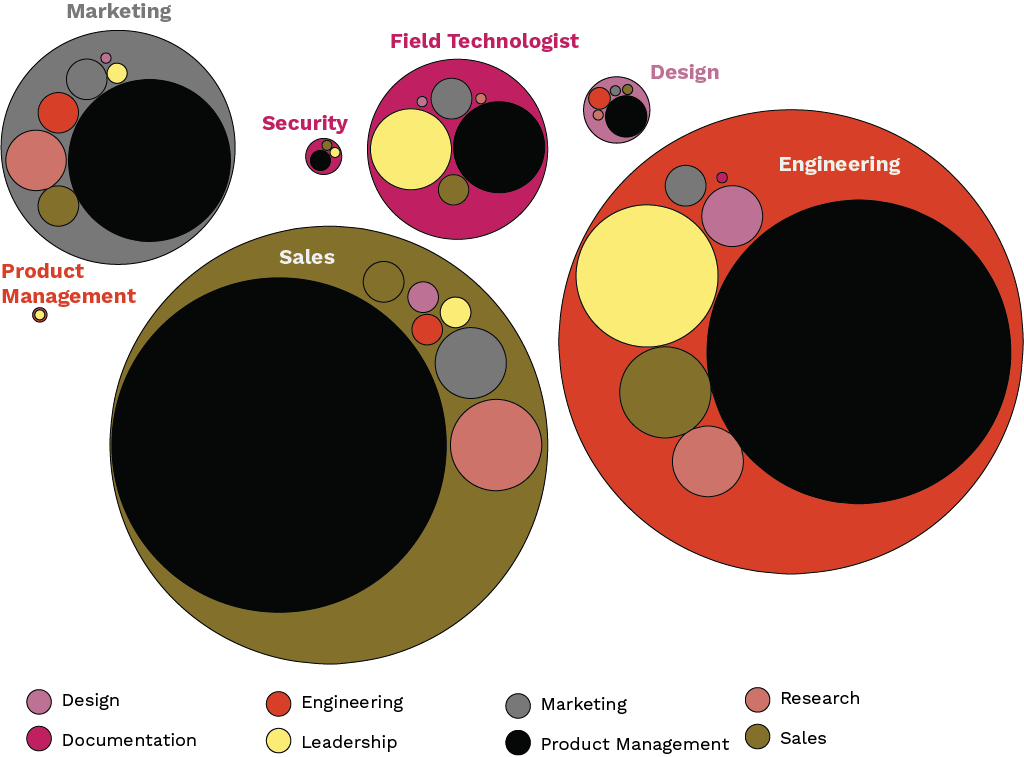
We determined that the primary barriers to effective collaboration were intrusive cross-functional behaviors as well as a failure to communicate among teams with shared goals.
This behavior was observed in any scenario in which a participant recounted taking control of a situation that was not their job to correct. It also emerged when participants described their feelings about a perceived lack of effectiveness in other departments.
The larger the circles, the more opinions the group shared about how other departments should operate. Similarly the size of the inner circles represent the number of comments made about each department.
Significant Research Findings Sample
The Venn diagram represents collaboration patterns described by participants. Intersecting circles in the diagram represent collaborative guidance and direction between teams. Circles that do not intersect represent failed collaboration attempts leading to blocked progress (as described by participants). As a function Product Management is meant to be the bridge between business, technology, and users. Ideally, the collaboration pattern would center around Product Management, aiming for trust and healthy communication through appropriate channels.
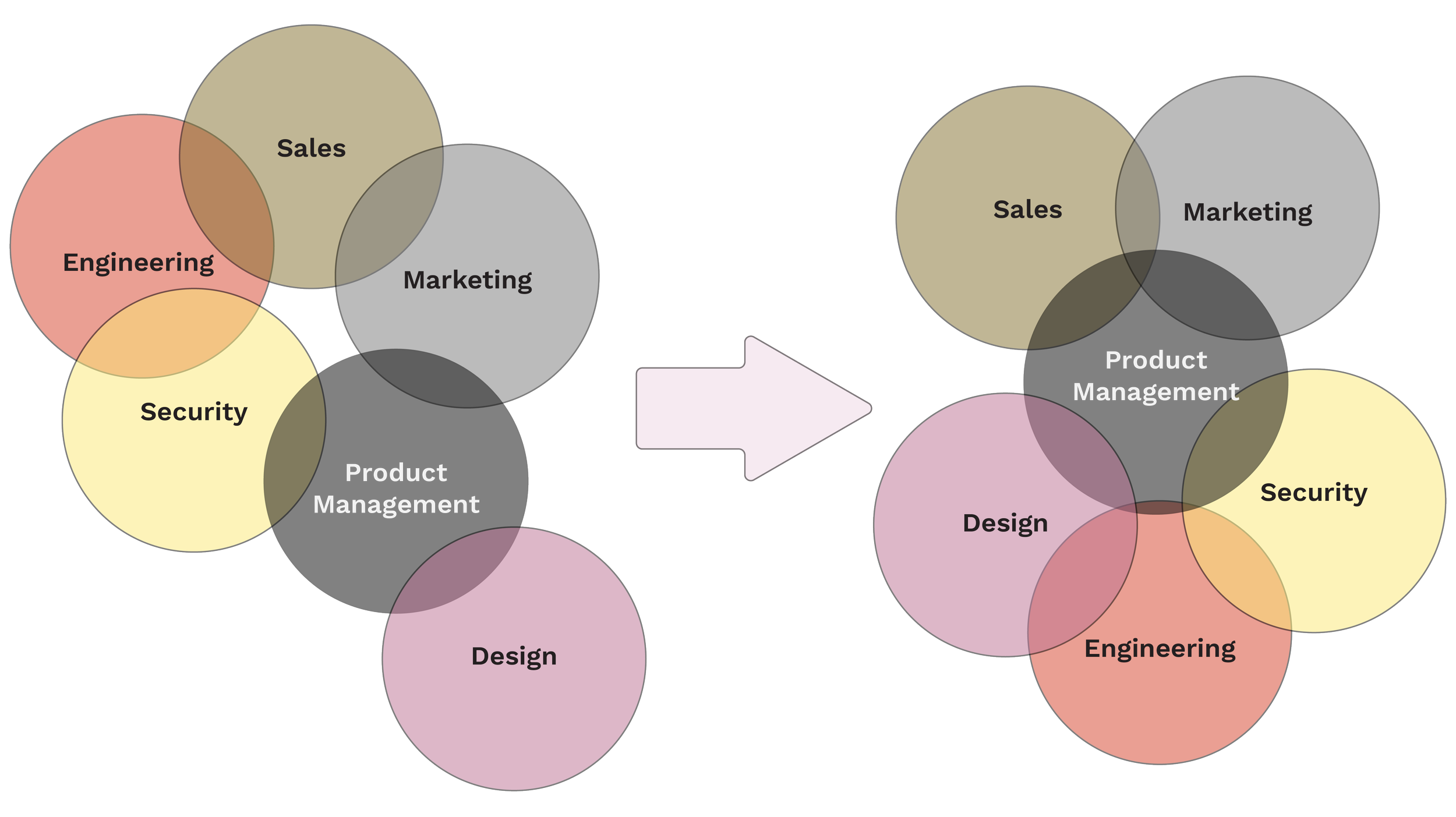
Observed collaboration pattern >>> Ideal collaboration pattern
Significant Research Findings Sample
Finally, we provided the leadership team and Human Resources department with recommended methods to correct the identified organizational failures.